
Short answer: yes, it matters, but not the way most course ads make it sound. It's not a legal requirement, nobody's checking for a license before you take on a client. What it actually does is compress the time it takes to look credible and get hired, especially if you're starting from zero. Whether that compression is worth the money depends entirely on where you're starting from and what you're trying to do next. Let's actually unpack that instead of just cheerleading it.
Also Read : Career Guide to becoming an Interior Designer
What a Certification Actually Signals to Employers/Clients
Here's the thing nobody says plainly enough: a certification isn't proof you're talented. It's proof you showed up, finished something, and can be trusted to follow a structured process, which, weirdly, is often what employers and clients actually care about more than raw creative flair.
For employers, a certification signals baseline competency. You know color theory, you understand space planning fundamentals, you've been exposed to material knowledge and basic software, so they're not starting your training from absolute zero. That saves them time, and time is money in a studio that's juggling live projects.
For clients, especially ones you're pitching directly as a freelancer, a certification does something slightly different: it builds trust fast. India doesn't license interior stylists, so there's genuinely no formal way for a client to verify you know what you're doing beyond your portfolio and whatever credentials you can show them. A recognized certificate becomes a shortcut, it tells a nervous client "this person has been trained by someone reputable," which matters a lot when you're asking them to hand over their home or their budget to a stranger.
What it doesn't signal, and this is important, is that you're actually good at the job. Plenty of certified people have thin portfolios and weak client instincts. Plenty of uncertified people are excellent stylists who learned entirely through practice and apprenticeship. The certification opens the door faster. It doesn't walk through it for you.
Also Explore : Interior Stylist Jobs in India
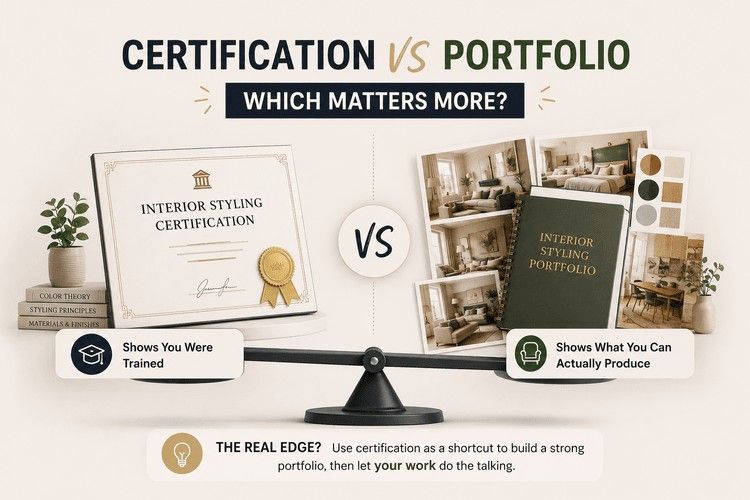
Certification vs Portfolio , Which Matters More?
Honestly? Portfolio wins, almost every time, once you're past the very first interview or client pitch.
Here's why: a certificate tells someone you were trained. A portfolio tells them what you can actually produce. Employers hiring for styling roles, especially anything photography-adjacent, brand shoots, e-commerce styling, are going to look at your actual work before they care what program you completed. The same goes for clients evaluating a freelancer, they want to see styled spaces, not diplomas.
But, and this is the honest nuance most articles skip, certification and portfolio aren't actually competing. A good certification program is one of the fastest ways to build a portfolio in the first place, especially if you have zero paid work history. Structured courses that include real or simulated client projects hand you exactly the kind of documented, process-driven work that a strong portfolio needs. So the real comparison isn't "certification versus portfolio," it's "certification as a portfolio-building shortcut versus building one slowly and informally on your own."
If you already have 8–10 strong, well-documented projects from internships, freelance gigs, or self-initiated work, a certification adds less marginal value; you've already proven what it would prove. If you have zero real projects and no professional network, a certification, especially one that includes live briefs, is often the faster path to something you can actually show someone.
Also Read: How to Build a Stunning Interior Design Portfolio in 2026
What to Check Before Choosing a Certification
Not all certifications carry equal weight, and the market has a fair number of programs that are long on marketing and short on substance. A few things worth checking before you pay for one.
Who's actually delivering it. Is it taught by working professionals or by people who've never run a live project? Programs led by active designers and stylists tend to teach the operational, messy realities of the job, not just theory.
Does it include real project work, not just tutorials. A course that has you styling actual briefs, ideally with feedback from a mentor, builds a portfolio alongside the learning. A course that's purely video lectures builds knowledge but nothing you can show a client.
Institutional credibility matters more than the certificate's design. Look for partnerships or affiliations that mean something to an employer, recognized ed-tech partnerships (Kaarwan, for instance, is a Google for Education partner) carry more weight with hiring managers than a generic completion certificate from an unaccredited platform, simply because it signals the program itself has been vetted by someone outside the course provider.
Placement or industry-connection support. Not every program needs to guarantee a job, that's an unrealistic promise anyway, but ones that actively connect you to studios, freelance networks, or mentors are doing more than just teaching content.
Realistic time and cost versus what you'll get out of it. A 6–8 week program that costs a few thousand rupees and gets you a real portfolio piece is often better value than an expensive multi-month program that's mostly theory.
Also Read: How Big Is the Interior Styling Industry in India Right Now?
Freelance vs Employed , Does Certification Weight Differently?
Yes, meaningfully so.
If you're aiming for employed roles, at a studio, a brand's in-house styling team, a furniture retailer, certification matters most at the application stage, getting your resume past the initial filter and into an interview. Once you're in the room, your portfolio and how you talk about your process take over. Employers hiring full-time are also evaluating soft factors, communication, reliability, whether you'd hold up under production deadlines, that no certificate can prove on its own.
If you're going freelance, certification does more ongoing work, because you don't have an employer's reputation lending you credibility. Every new client is evaluating you from scratch, and a recognized certification is one of the few fast, low-friction ways to establish trust before they've seen your actual work. This is especially true for higher-budget residential clients who are handing over real money to someone with no institutional backing, a credential reduces the perceived risk of hiring you.
The freelance case for certification is genuinely stronger than the employed case, which is a bit counterintuitive given how much freelance advice online focuses purely on portfolio and networking.
Considering whether a structured program is the right next step? Kaarwan's interior styling masterclass includes real project briefs and a Google for Education-recognized certificate, built for exactly this decision point.
Common Regrets People Have After Certifying (or Not)
A few honest patterns show up repeatedly when you talk to people who've been through this decision.
The regret of certifying too early, before knowing what they wanted. Some people jump into a broad certification before figuring out whether they want employed studio work, freelance residential styling, or brand/e-commerce styling, three genuinely different skill emphases. They end up with a generalist credential that doesn't sharply support any one path.
The regret of not certifying, and losing time to informal learning that never quite crystallized. Self-teaching works, but without structure and deadlines, a lot of people spend a year "learning styling" through scattered YouTube videos and never actually produce a coherent portfolio, because nothing forced them to finish and document real projects.
The regret of choosing based on price alone. The cheapest certification often skips the parts that matter most, live briefs, mentor feedback, industry connections, leaving people with a certificate that looks fine on paper but didn't actually build anything usable.
Rarely regretted: choosing a program specifically because it included real project work. This is the one factor that consistently shows up as "worth it" in hindsight, regardless of price or duration, because it's the thing that actually produces a usable portfolio alongside the credential.
Also Read : Difference between Interior Architecture and Interior Design
Conclusion
A certification isn't a magic ticket, and it's not required by law either. What it actually does, when it's a good one, is compress months of scattered self-teaching into a structured few weeks, with real project work to show for it at the end. If you're starting from zero and need to move fast, that's genuinely worth paying for. If you already have a strong portfolio, it matters less. Either way, the decision comes down to what specific gap you're trying to close.
Ready to close that gap deliberately? Explore Kaarwan's interior styling masterclass and start building a portfolio alongside your credential, not instead of it.
FAQs
Is a certification necessary to become an interior stylist in India?
No, it's not legally required. India has no licensing body for interior styling. That said, a certification meaningfully speeds up building client trust and a usable portfolio, especially for beginners with no existing network or project history.
Certification for Styling vs a Full Interior Design Degree , Which Should I Choose?
It depends on your target role. A styling-specific certification is faster and cheaper, and fits well if you're focused on visual/curatorial work like photography styling, brand shoots, or residential styling. A full interior design degree covers technical scope, layouts, construction coordination, that styling doesn't touch, and suits people aiming for broader design roles. If you're weighing this choice specifically, it helps to look at how certification affects hiring odds for styling-focused paths before deciding.
How long does a good interior styling certification take?
Most credible programs run 6 to 12 weeks for a focused certification, though some longer diploma-style programs extend to several months. Length isn't the main quality signal, whether it includes real project work is.
Will a certification guarantee me a job or clients?
No program can honestly guarantee that. What a good certification does is meaningfully shorten the distance between "no experience" and "hireable portfolio," which improves your odds, but the actual outreach, interviewing, and client-pitching work is still yours to do.